


Page 144 - catalgo33
P. 144
dIAl IndIcAtors                                       ApplIcAtIon specIfIcAtIon fActors
                                                                       1. Regular analog styles with indicating hands are more readable
                                  I
               MecHAnIcAl dIAl ndIcAtors And AttAcHMents                 than digital styles when the measurements are being visually
                                                                         monitored by an operator.
               electronIc IndIcAtors/IndIcAtor Holders
               Accurate, rugged, versatile, convenient to use and inexpensive – for   2. Select the dial size that gives you the readability you need. We
                                                                         offer five regular dial sizes which will fit most applications that
               these reasons and more, mechanical dial indicators with bottom
          IndIca tors and GaGes  Electronic indicators have an unmatched ability for the accurate   3. Choose the accuracy and readout you need – don't select a
                                                                         have both space limitations and readability requirements.
               plungers are the measurement workhorses of industrial production.
                                                                         .0001" (or 0.001mm) readout if .001" (or 0.01mm) will do
               recording of a great amount of measurement data which is used in a
                                                                         your job.
               variety of Statistical Process Control (SPC) operations.
                                                                       4. Electronic styles are best when the measurement data needs
               The first part of this section shows our complete line of mechanical/
                                                                         to be collected, printed out or stored for future use.
               analog dial indicators – over 180 models to give you the widest
                                                                       5. Consider any special features you may need – inch or
               selection in the industry. Our comparison guide, following these
                                                                         millimeter reading, special shockless movement, antimagnetic,
               introduction pages, has all the significant specifications to help you
               make your selection.
                                                                         long range, long stem, special backs, special contacts, special
                                                                         holders, etc. If you don't see what you need, please contact
                                                                         our Special Order Department. Even though we have a broad
                                                                         line of indicators to tackle most jobs, we also do a lot of special
                                                                         design, catering to the specific needs of our customers –
                                                                         challenge us!
                                                                       6. Starrett indicators are made to  American Gage Design
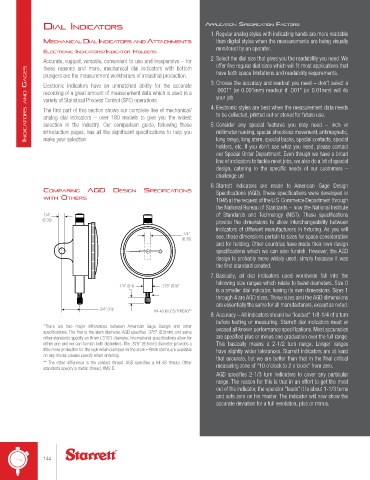
               coMpArInG  AGd  desIGn  specIfIcAtIons                    Specifications (AGD). These specifications were developed in
               WItH otHers                                               1945 at the request of the U.S. Commerce Department through
                                                                         the National Bureau of Standards – now the National Institute
               1/4"                                                      of Standards  and  Technology (NIST).  These  specifications
               (6.35)                                                    provide the dimensions to allow interchangeability between
                                                                         indicators of different manufacturers in fixturing. As you will
                                                              1/4"       see, these dimensions pertain to sizes for space consideration
                                                             (6.35)
                                                                         and for holding. Other countries have made their own design
                                                                         specifications which we can also furnish. However, the AGD
                                                                         design is probably more widely used, simply because it was
                                                                         the first standard created.
                                                                       7. Basically, all dial indicators used worldwide fall into the
                                                                         following size ranges which relate to bezel diameters. Size 0
                                         1/4" (6.4)   .375" (9.5)*
                                                                         is a smaller dial indicator, having its own dimensions. Sizes 1
                                                                         through 4 are AGD sizes. These sizes and the AGD dimensions
                                                                         are essentially the same for all manufacturers, except as noted.
                                  3/4" (19)         #4-48 (M 2.5) THREAD**
                                                                       8. Accuracy – All indicators should be "loaded" 1/8-1/4 of a turn
                                                                         before testing or measuring. Starrett dial indicators meet or
               *There are two major differences between  American Gage Design and other   exceed all known performance specifications. Most accuracies
               specifications. The first is the stem diameter. AGD specifies .375" (9.5mm) and some
               other standards specify an 8mm (.315") diameter. International specifications allow for   are specified plus or minus one graduation over the full range.
               either one and we can furnish both diameters. The .375" (9.5mm) diameter provides a   This basically means a 2-1/2 turn range. Longer ranges
               little more protection for the rack when clamped on the stem – 8mm stems are available   have slightly wider tolerances. Starrett indicators are at least
               on any model, please specify when ordering.               that accurate, but we are better than that in the final critical
               ** The other difference is the contact thread. AGD specifies a #4-48 thread. Other   measuring zone of "10 o'clock to 2 o'clock" from zero.
               standards specify a metric thread, #M2.5.
                                                                         AGD specifies 2-1/3 turn indicators to cover any particular
                                                                         range. The reason for this is that in an effort to get the most
                                                                         out of the indicator, the operator "loads" it to about 1-1/3 turns
                                                                         and sets zero on his master. The indicator will now show the
                                                                         accurate deviation for a full revolution, plus or minus.


               144

