


Page 77 - catalgo33
P. 77
end MeAsurInG rods

        precIsIon end MeAsurInG rods And                           Unless otherwise noted under the individual tools, all have
                                                                   these features:
        InsIde MIcroMeters
        The following pages show our varied line of precision end measuring rods   •  Balanced design for better feel and accurate measurement
        and inside micrometers.  The variations are fixed-range or adjustable-range   •  All contact points are hardened and ground for better
        micrometers and solid or tubular measuring rods.               accuracy and long life
                                                                     •  Satin chrome finish on all micrometer heads and
                                                                       reading surfaces that resist rust and also make for
                                                                       easy reading by providing a no-glare background for
                                                                       the sharp lines and figures
                                  824B                               •  Hardened and stabilized spindle for accuracy and long life
                                                           128       •  Advanced sleeve design with staggered lines and   MicroMeters
                                                                       distinct figures for precise and easy readability
                                                                     •  Quick and easy adjustment
                                                             234A-4
                                                                     •  Starrett workmanship
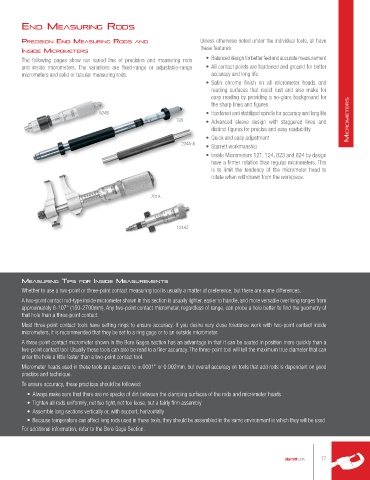
                                                                     •  Inside Micrometers 121, 124, 823 and 824 by design
                                                                       have a firmer rotation than regular micrometers. This
                                                                       is to limit the tendency of the micrometer head to
                                                                       rotate when withdrawn from the workpiece.


                                                   701A


                                                           124AZ


        MeAsurInG tIps for InsIde MeAsureMents
        Whether to use a two-point or three-point contact measuring tool is usually a matter of preference, but there are some differences.
        A two-point contact rod-type inside micrometer shown in this section is usually lighter, easier to handle, and more versatile over long ranges from
        approximately 6-107" (150-2700mm). Any two-point contact micrometer, regardless of range, can probe a hole better to find the geometry of
        that hole than a three-point contact.
        Most three-point contact tools have setting rings to ensure accuracy. If you desire very close tolerance work with two-point contact inside
        micrometers, it is recommended that they be set to a ring gage or to an outside micrometer.
        A three-point contact micrometer shown in the Bore Gages section has an advantage in that it can be seated in position more quickly than a
        two-point contact tool. Usually these tools can also be read to a finer accuracy. The three-point tool will tell the maximum true diameter that can
        enter the hole a little faster than a two-point contact tool.
        Micrometer heads used in these tools are accurate to ±.0001" or 0.002mm, but overall accuracy on tools that add rods is dependent on good
        practice and technique.
        To ensure accuracy, these practices should be followed:
          •  Always make sure that there are no specks of dirt between the clamping surfaces of the rods and micrometer heads
          •  Tighten all rods uniformly, not too tight, not too loose, but a fairly firm assembly
          •  Assemble long sections vertically or, with support, horizontally
          •  Because temperature can affect long rods used in these tools, they should be assembled in the same environment in which they will be used
        For additional information, refer to the Bore Gage Section.


                                                                                               starrett.com  77

