


Page 113 - catalgo33
P. 113
HoW to reAd A stArrett 50-dIvIsIon vernIer HeIGHt GAGe GrAduAted In IncHes And
MIllIMeters (dIrect reAdInG)
IncH reAdInG
• Refer to the left side bar graduations and the inch vernier plate.
Inches are numbered in sequence over the full range of the bar.
Each bar graduation is .050". Every second graduation between
the inch lines is numbered and equals .100".
• The vernier plate is divided into 50 parts, each representing
.001". Every fifth line is numbered – 5, 10, 15 … 45, 50 – for
easy counting.
• To read the gage, first count how many inches and how many
.050" lines lie between the zero line on the bar and the zero line
on the vernier plate and add them. HeigHt gages
• Then count the number of graduations on the vernier plate from
its zero line to the line that coincides with a line on the bar. C
Multiply the number of vernier plate graduations you counted
by .001" and add this figure to the number of inches and .050"
lines you counted on the bar. This is your total reading.
exAMple
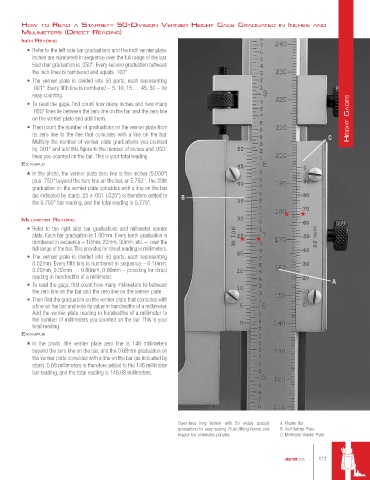
In the photo, the vernier plate zero line is five inches (5.000")
plus .750" beyond the zero line on the bar, or 5.750". The 25th
graduation on the vernier plate coincides with a line on the bar
(as indicated by stars). 25 x .001 (.025") is therefore added to B
the 5.750" bar reading, and the total reading is 5.775".
MIllIMeter reAdInG
• Refer to the right side bar graduations and millimeter vernier
plate. Each bar graduation is 1.00mm. Every tenth graduation is
numbered in sequence – 10mm, 20mm, 30mm, etc. – over the
full range of the bar. This provides for direct reading in millimeters.
• The vernier plate is divided into 50 parts, each representing
0.02mm. Every fifth line is numbered in sequence – 0.10mm,
0.20mm, 0.30mm … 0.80mm, 0.90mm – providing for direct
reading in hundredths of a millimeter.
• To read the gage, first count how many millimeters lie between A
the zero line on the bar and the zero line on the vernier plate.
• Then find the graduation on the vernier plate that coincides with
a line on the bar and note its value in hundredths of a millimeter.
Add the vernier plate reading in hundredths of a millimeter to
the number of millimeters you counted on the bar. This is your
total reading.
exAMple
In the photo, the vernier plate zero line is 146 millimeters
beyond the zero line on the bar, and the 0.68mm graduation on
the vernier plate coincides with a line on the bar (as indicated by
stars). 0.68 millimeters is therefore added to the 146 millimeter
bar reading, and the total reading is 146.68 millimeters.
Open-face long Vernier with 50 widely spaced A. Master Bar
graduations for easy reading. Flush-fitting Vernier and B. Inch Vernier Plate
master bar eliminates parallax. C. Millimeter Vernier Plate
starrett.com 113

